Introduction
Picture a hungry person on a street corner typing “best pizza near me.” A map appears with three businesses at the top, and one of them is about to win a new customer.
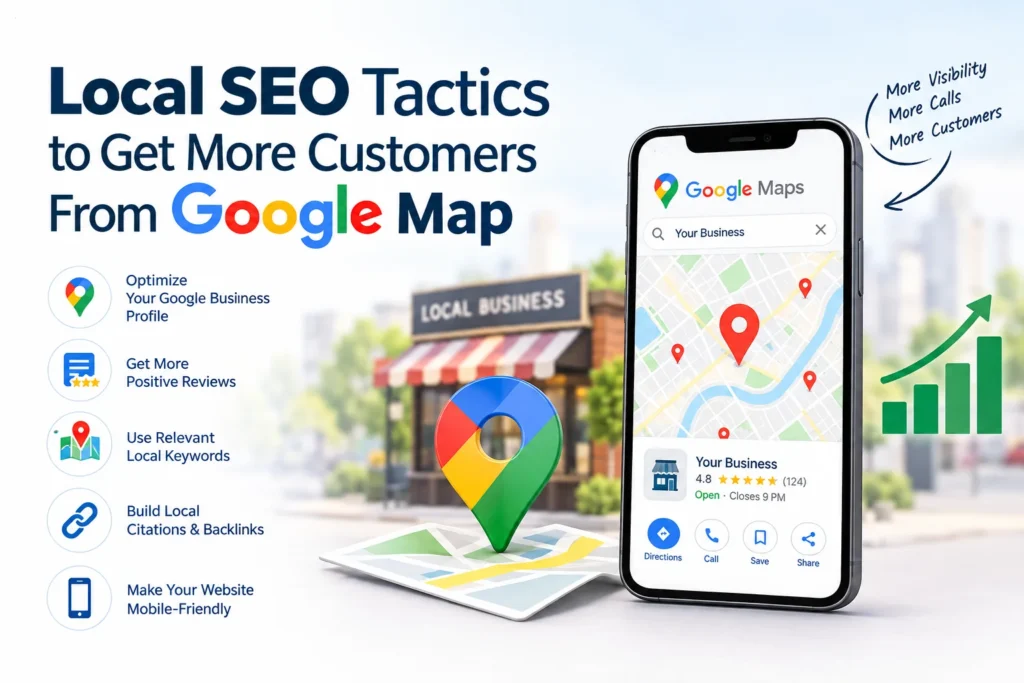
Those top spots are not an accident. Businesses earn them with proven local SEO tactics that help Google trust them and show them to nearby searchers.
This guide covers ten practical local SEO tactics that small business owners can start using today.
What you will learn:
- How Google Maps ranking works
- Ten clear steps to improve visibility
- Common mistakes to avoid
- A simple plan to follow
Why Google Maps Is Worth Your Attention
Google Maps is now the first stop for people looking for nearby services. Many shoppers choose from the map before they ever visit a website.
The top three listings, known as the local pack, collect most of the clicks. Those clicks quickly become phone calls, direction requests, and walk-ins.
What the local pack brings:
- More phone calls
- More direction requests
- More website visits
- More foot traffic
Ranking there does not need a giant budget. It takes consistency and accuracy, which is what these local SEO tactics are built around.
How Google Decides Who Shows Up
Google ranks nearby businesses using three main factors. Owners cannot change distance, but they can strengthen the other two.
| Factor | What It Means | Can You Improve It? |
|---|---|---|
| Relevance | How well the listing matches the search | ✅ Yes |
| Distance | How close the business is to the searcher | ❌ No |
| Prominence | How well known and trusted the business is | ✅ Yes |
The 10 Tactics, Step by Step
1. Claim and Verify Your Google Business Profile
Everything starts here. The Google Business Profile is the free listing that powers a business’s presence on Google Maps.
Owners can search for their business name and claim it. If no listing exists, creating one takes only a few minutes.
Common verification methods:
- Video
- Phone
- Postcard
Verification proves the business is real and gives the owner full control. Treat it as the foundation of all local SEO tactics.
2. Choose the Right Categories
Categories tell Google what a business actually does. They are among the strongest relevance signals in the whole profile.
The primary category should match the main service as closely as possible. An “Italian Restaurant” will usually beat a general “Restaurant” for pasta searches.
Category tips:
- Pick the most specific primary category
- Add secondary categories that truly apply
- Avoid unrelated categories that blur the focus
3. Fill Out Every Section Completely
Complete profiles look more trustworthy to Google and customers alike. Empty fields suggest a business that does not care about details.
Fields to complete:
- Business name
- Address and service area
- Phone number and website
- Opening hours, including holidays
- Services and attributes
- Business description
Write the description in a friendly, natural voice. Avoid stuffing it with repeated phrases.
Completing every field is one of the simplest local SEO tactics available. Yet many profiles still leave half the boxes empty.
4. Add Fresh, High-Quality Photos and Videos
People judge a business with their eyes first. Listings with real photos earn more clicks, calls, and direction requests.
Photos worth uploading:
- Storefront and entrance
- Interior and seating
- Team members
- Products or finished work
- Parking area
A modern phone camera is good enough. Natural light and a clean background matter more than expensive gear.
Short videos add a personal touch. Uploading a few new images each month also shows the business is active.
5. Collect and Answer Customer Reviews
Reviews are the heartbeat of local rankings. Google reads their quantity, quality, and freshness, and customers use them to decide.
Happy customers rarely leave feedback on their own. A friendly ask at checkout or a text with a direct review link can change that.
How to get more reviews:
- Ask in person after a good experience
- Send a short text or email with the link
- Add a QR code at the counter
- Reply to every review within a few days
Of all local SEO tactics, steady review building is one of the most powerful. Aim for a regular trickle rather than a sudden flood.
6. Keep Citations and Contact Details Consistent
A citation is any online mention of a business’s name, address, and phone number, often shortened to NAP. Directories, social profiles, and local chambers all count.
Google compares these mentions across the web. When details match, trust grows, and when they conflict, rankings can slip.
Quick cleanup steps:
- Choose one exact format for name, address, and phone
- Search major directories for the business
- Fix anything that differs
- Record every listing in a spreadsheet
Cleaning up citations is not glamorous, but it ranks among the most dependable local SEO tactics.
7. Use Google Posts, Q&A, and Messaging
Regular posts about offers, events, and news appear right on the listing. They give searchers a reason to choose one business over another.
Three features to use:
- Posts: share offers and updates
- Q&A: add common questions and answers first
- Messaging: reply fast to quick customer questions
These small touches show a real person is behind the profile. That often nudges a customer to tap the call button.
8. Optimize the Website for Local Searches
The website supports the listing, and Google checks that the two agree. The name, address, and phone number should be clear on the site.
Website checklist:
- NAP in the footer and on the contact page
- A unique page for each location
- Service and area in titles and headings
- Local business schema markup
- Fast loading and mobile-friendly design
Avoid copying one page and swapping the city name. Each page needs its own landmarks, stories, and details.
Among all local SEO tactics, a fast mobile site often decides whether a visitor stays or leaves.
9. Earn Links From Local Sources
Links from respected local websites act like votes of confidence. They tell Google the business is a real part of its community.
Easy ways to earn local links:
- Sponsor a youth sports team
- Join the chamber of commerce
- Host or support a charity event
- Partner with nearby businesses
- Share stories with local bloggers and news sites
Quality beats quantity every time. A few genuine local links often outperform dozens of random ones, making this one of the more underrated local SEO tactics.
10. Track Results and Keep Improving
What gets measured gets better. Profile performance data shows how many people called, asked for directions, or visited the website.
Numbers worth watching:
- Profile views
- Phone calls
- Direction requests
- Website clicks
- Ranking for key searches from different spots
Look at what changed after each update. That insight shows where to invest more time.
Treat the process as a habit, not a one-time project. The most successful local SEO tactics are repeated month after month.
| # | Tactic | Main Benefit |
|---|---|---|
| 1 | Claim and verify profile | Control and credibility |
| 2 | Right categories | Stronger relevance |
| 3 | Complete every section | Higher trust |
| 4 | Photos and videos | More clicks |
| 5 | Reviews | Better rankings |
| 6 | Consistent citations | Stronger trust signals |
| 7 | Posts, Q&A, messaging | More engagement |
| 8 | Local website | Matching signals |
| 9 | Local links | Higher prominence |
| 10 | Track results | Ongoing growth |
Common Mistakes That Hold Listings Back
Some mistakes can quietly damage a listing or even get it suspended.
Avoid these:
- Stuffing keywords into the business name
- Posting fake reviews
- Using a mailbox or virtual office as a location
- Ignoring negative reviews
- Leaving hours outdated
A polite, solution-focused reply to a bad review can win back trust. It also shows everyone else that the business cares.
Putting It All Together
Success on Google Maps does not come from one trick. It comes from steady habits that build relevance, trust, and visibility over time.
A simple starter plan:
- Week 1: Claim the profile and pick categories
- Week 2: Complete every section and add photos
- Week 3: Start asking for reviews
- Week 4: Clean up citations
- Ongoing: Improve the website, earn links, and track results
Even a few hours a week creates momentum. Applying these local SEO tactics consistently helps customers who once scrolled past a business start noticing it first.
Frequently Asked Questions
1. What are local SEO tactics?
Local SEO tactics are steps that help a business show up when people search for nearby services. They include optimizing a Google Business Profile, collecting reviews, and keeping contact details consistent online.
2. How long does it take to rank on Google Maps?
Most businesses start seeing movement within one to three months. Highly competitive areas can take longer, so steady effort matters more than quick fixes.
3. Is a Google Business Profile free?
Yes, creating and managing a profile costs nothing. Owners only pay if they choose to run Google Ads on top of it.
4. How many reviews does a business need?
There is no magic number. Google looks at quantity, quality, and how recent the reviews are, so a steady flow of honest feedback beats a one-time burst.
5. Can a business without a storefront rank on Google Maps?
Yes. Service-area businesses, such as plumbers or cleaners, can hide their home address and list the areas they serve instead.
6. Do I need a website to appear on Google Maps?
A website is not strictly required, but it helps a lot. It gives Google more signals to confirm the business is real, and it gives customers more information.
7. What is NAP, and why does it matter?
NAP stands for name, address, and phone number. When these details match across every directory and profile, Google trusts the listing more.
8. How often should a profile be updated?
A quick check once a month works well for most owners.
A simple monthly routine:
- Add a few new photos
- Publish one post
- Reply to new reviews
- Confirm hours and contact details
9. Should I respond to negative reviews?
Yes, and calmly. A polite, helpful reply shows future customers that the business listens and cares.
10. Can small businesses really compete with big brands?
Absolutely. Local searches reward relevance, proximity, and trust, so a well-managed neighborhood business can outrank a larger competitor by applying consistent local SEO tactics.
Final Thoughts
Getting noticed on Google Maps is no longer a mystery reserved for big brands. With patience and the right local SEO tactics, a neighborhood shop can compete with much larger rivals.
Choose one step, start today, and let each small win bring more calls, more visits, and more loyal customers.