Learn how local SEO increases profits by attracting high-intent customers, generating qualified leads, improving conversions, reducing acquisition costs, and building long-term revenue growth.
In today’s digital marketplace, customers often turn to Google when they need a product or service nearby. Whether someone is searching for a plumber, dentist, restaurant, lawyer, construction company, or electrician, appearing prominently in local search can put a business in front of potential customers at the exact moment they are ready to take action.
But rankings alone do not generate profit.
The real value comes from turning local visibility into qualified leads, customers, revenue, and long-term business growth. This is why understanding how local SEO increases profits is important for businesses that want to make their marketing investment more effective.
The process is simple:
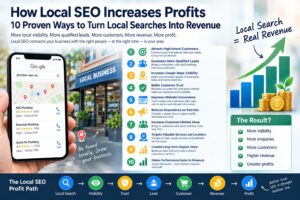
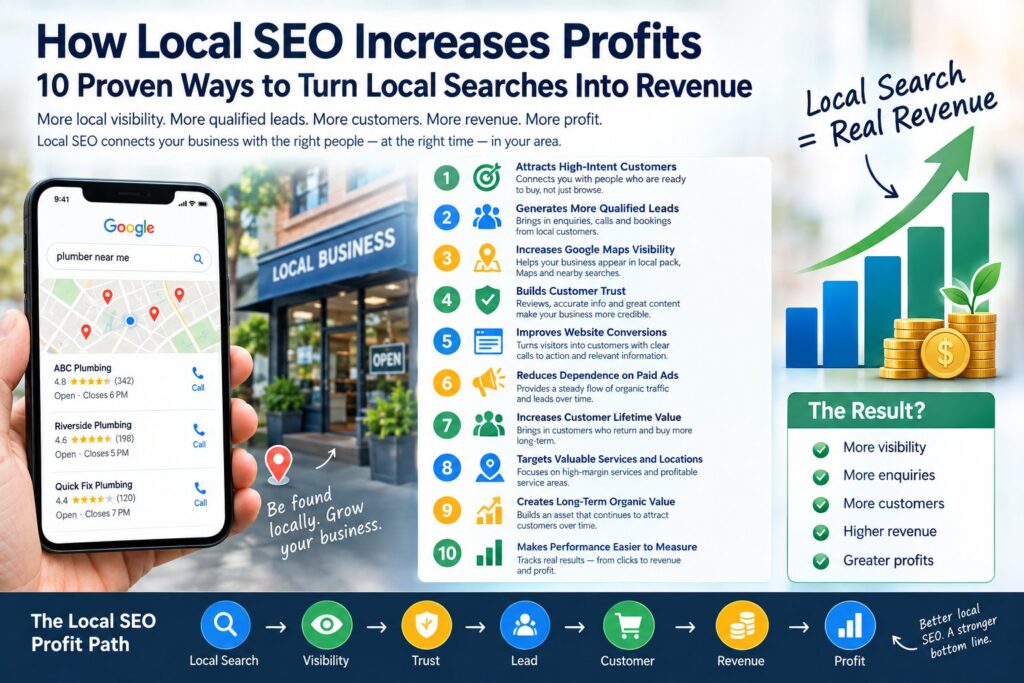
Local visibility → Qualified traffic → Leads → Customers → Revenue → Profit
A successful local SEO strategy can help businesses attract high-intent customers, increase enquiries, build trust, improve website conversions, and reduce dependence on paid advertising.

What Is Local SEO?
Local SEO is the process of optimizing a business’s online presence to improve its visibility for searches connected to a specific location.
Examples include:
- “Plumber near me”
- “Dentist in Manchester”
- “Electrician in Birmingham”
- “Best restaurant near me”
- “Roofing company in London”
- “Accountant in Sydney”
Unlike traditional SEO, which can target broad national or international audiences, local SEO focuses on customers within a defined service area.
Common local SEO activities include:
- Google Business Profile optimization
- Local keyword research
- Service and location pages
- Technical SEO
- Review management
- Local citations
- Relevant backlinks
- Local content
- Conversion optimization
The goal is not simply to generate more visitors. It is to attract people who are actually capable of becoming customers.
How Local SEO Increases Profits
The answer to how local SEO increases profits starts with customer intent.
A person searching for “what is a roof?” may simply be researching.
Someone searching for “roof repair company near me” has a much stronger commercial reason for searching.
Local SEO helps businesses appear during these important moments when customers are actively looking for a solution.
Here are 10 ways local SEO can contribute to higher revenue and profitability.
1. Attracts High-Intent Customers
One of the biggest advantages of local search is that it can connect businesses with people who already need a product or service.
Consider searches such as:
- “emergency plumber near me”
- “dentist open today”
- “car repair near me”
- “commercial electrician in Birmingham”
These searches can indicate that the customer is closer to making a purchasing decision.
For businesses, this means they do not necessarily need millions of visitors. They need the right visitors.
A smaller number of highly relevant local visitors can produce more business than thousands of visitors from locations the company does not serve.
This makes search intent one of the most important factors when evaluating local SEO profitability.
2. Generates More Qualified Leads
Traffic is only valuable when it can eventually contribute to business results.
Local SEO can encourage customers to:
- Call the business
- Request a quotation
- Complete a contact form
- Book an appointment
- Send a message
- Visit a store
- Request a consultation
For example, a construction company ranking for “commercial construction company near me” can attract businesses actively looking for construction services.
The customer may visit a relevant service page, review previous projects, and submit a quote request.
The journey becomes:
Google search → Website → Enquiry → Sales conversation → Customer
Businesses should therefore measure qualified leads, rather than focusing only on traffic numbers.
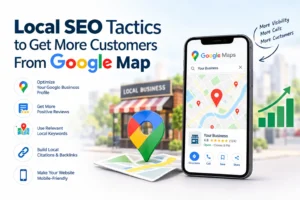
3. Increases Google Maps Visibility
Google Maps is an important discovery channel for many local businesses.
When someone searches for a nearby business, Google may display local business listings with information such as:
- Business name
- Location
- Opening hours
- Phone number
- Website
- Reviews
- Photos
- Directions
A complete and accurate Google Business Profile can make it easier for customers to evaluate a company.
For example, a person looking for a nearby restaurant may compare several options based on reviews, location, opening hours, photos, and convenience.
Better local visibility can therefore lead to more:
- Calls
- Website visits
- Bookings
- Direction requests
- Store visits
4. Builds Customer Trust
Customers want to feel confident before spending money.
Local SEO can support trust through a combination of:
- Positive reviews
- Accurate business information
- Professional website content
- Quality photos
- Local relevance
- Customer testimonials
- Clear service information
Imagine two local businesses offering the same service.
One has an outdated website and only a few reviews.
The other has a professional website, numerous genuine reviews, clear service information, recent photos, and an active online presence.
The second business may appear more credible.
This demonstrates an important part of how local SEO increases profits: visibility creates the opportunity, but trust can help turn that opportunity into a customer.
5. Improves Website Conversions
Getting visitors to your website is not enough.
The website must encourage them to take action.
A visitor searching for “roofing company near me” should quickly be able to understand:
- What services you provide
- Which areas you serve
- Why customers should choose you
- How to contact you
- How to request a quote
Important conversion elements include:
- Clear calls to action
- Click-to-call buttons
- Simple enquiry forms
- Service-specific pages
- Location information
- Reviews
- Case studies
- Project images
When local SEO and conversion optimization work together, businesses have a better opportunity to turn organic visitors into paying customers.
6. Can Reduce Dependence on Paid Advertising
Paid advertising can generate customers quickly, but it requires an ongoing advertising budget.
Organic search works differently.
Local SEO requires investment in areas such as content, website optimization, technical improvements, local listings, and ongoing management. However, organic search does not require a separate advertising payment for every organic click.
Over time, strong organic visibility can diversify a company’s customer acquisition channels.
This does not mean SEO is free.
The correct question is:
Does the value generated by SEO-attributed customers justify the cost of the SEO investment?
If the answer is yes, local SEO can become an increasingly valuable acquisition channel.
7. Increases Customer Lifetime Value
A customer is not always valuable because of the first purchase.
Many businesses rely on repeat customers.
For example:
- A cleaning company may receive recurring bookings.
- A dentist may have patients return for future appointments.
- A mechanic may provide ongoing vehicle maintenance.
- A restaurant may develop regular customers.
- A business consultant may receive repeat projects.
Suppose a customer generates $500 from their first transaction but later produces another $1,500 through repeat purchases.
Their total value is much greater than the initial sale.
Therefore, businesses should consider customer lifetime value (CLV) when measuring local SEO performance.
A successful local SEO campaign can become even more profitable when the customers it attracts continue buying from the business.
8. Targets Valuable Services and Locations
Not every service produces the same profit.
A company may offer several services, but some may have better margins or higher customer lifetime value.
For example, a contractor may provide:
- Small repairs
- Residential renovations
- Commercial construction
- Maintenance services
If commercial construction produces significantly higher-value projects, the SEO strategy should prioritize searches related to that service.
The same applies to locations.
A business may serve several cities, but some areas may produce better customers because they have:
- Higher demand
- Stronger purchasing power
- Less competition
- Higher average order values
- Better profit margins
This is why profitable local SEO is not simply about ranking for keywords with the highest search volume.
It is about ranking for commercially valuable searches.
9. Creates Long-Term Organic Marketing Value
One potential advantage of SEO is that optimized pages can continue attracting visitors after they have been created.
For example, a business could create a detailed page targeting:
“commercial electrician in Birmingham.”
If that page earns strong visibility and continues satisfying searchers, it may generate relevant visitors and enquiries over time.
However, local SEO is not completely passive.
- Competitors can improve their websites.
- Search behavior can change.
- Search engines can update their systems.
- Content can become outdated.
Therefore, businesses need to monitor and improve their local SEO presence.
The long-term opportunity is to build an organic asset that contributes to customer acquisition without depending entirely on continuous advertising spend.
10. Makes Marketing Performance Easier to Measure
Another important benefit is the ability to connect marketing activity with measurable business outcomes.
Businesses can monitor:
Visibility
- Local rankings
- Search impressions
- Organic clicks
- Google Business Profile activity
Leads
- Phone calls
- Form submissions
- Quote requests
- Bookings
Sales
- Qualified leads
- Customers gained
- Conversion rate
- Average transaction value
Financial Performance
- Revenue
- Contribution margin
- Customer acquisition cost
- Customer lifetime value
- SEO investment
This creates a much better way to understand how local SEO increases profits.
Rankings are useful, but the ultimate question is whether those rankings contribute to profitable customers.
How to Calculate Local SEO ROI
A simple way to evaluate SEO profitability is:
SEO ROI = (SEO-attributed profit − SEO cost) ÷ SEO cost × 100
For example:
SEO investment = $5,000
Additional SEO-attributed profit = $15,000
ROI:
($15,000 − $5,000) ÷ $5,000 × 100 = 200%
This is only an example because attribution can be complicated.
A customer might discover a business through Google, return later through another channel, and eventually make a purchase.
Therefore, businesses should avoid claiming that every sale came exclusively from SEO.
Using call tracking, analytics, lead tracking, CRM data, and conversion measurement can provide a more realistic picture.
Common Local SEO Mistakes That Reduce Profit
Local SEO can underperform when businesses focus on the wrong objectives.
Targeting Traffic Instead of Intent
Large traffic numbers do not matter if visitors cannot become customers.
Ignoring Google Business Profile
An incomplete or outdated profile can create a poor first impression.
Using Generic Website Content
Customers need specific information about the service and location.
Ignoring Reviews
Reviews can strongly influence customer confidence.
Not Tracking Leads
Without tracking calls and enquiries, it is difficult to calculate business value.
Responding Slowly
A potential customer may contact a competitor if their enquiry is ignored.
Measuring Rankings Alone
A ranking position is an SEO metric, not a profit statement.
How to Build a Profitable Local SEO Strategy
A strong strategy can follow these steps:
- Identify profitable services and prioritize the services that generate strong margins.
- Define your service areas and focus on locations you can realistically serve.
- Research local search intent to find commercially valuable queries.
- Optimize your Google Business Profile with accurate and useful information.
- Create strong service and location pages that answer customer questions.
- Build genuine reviews and reputation through excellent customer service.
- Improve website conversions with clear calls to action and simple contact options.
- Track calls, enquiries, and sales rather than relying only on rankings.
- Measure customer value through revenue, margins, and lifetime value.
- Continue optimizing based on the services and locations generating the strongest results.
Frequently Asked Questions
How does local SEO increase profits?
Local SEO can increase profits by helping businesses reach relevant local customers, generate qualified enquiries, improve conversions, and acquire customers through organic search. Profitability depends on customer value, margins, conversion rates, and the cost of SEO.
Does local SEO guarantee more customers?
No. Local SEO can increase visibility and opportunities but cannot guarantee a specific number of customers or sales.
Is local SEO better than Google Ads?
Neither channel is automatically better. Paid advertising can generate immediate visibility, while SEO can build longer-term organic visibility. Many businesses can benefit from using both.
How long does local SEO take to work?
There is no fixed timeframe. Competition, website quality, search demand, authority, content, reviews, and the amount of optimization required all affect results.
Can local SEO reduce customer acquisition costs?
It can potentially reduce acquisition costs over time by generating organic customers without a direct advertising cost for every click. However, SEO still requires investment.
Is Google Business Profile important for local SEO?
Yes. It is an important part of local search visibility for many businesses and helps potential customers access essential business information.
Is more local traffic always better?
No. Qualified traffic is more valuable than irrelevant traffic. The best traffic comes from customers who need your services and are located within your target market.
Conclusion
The real answer to how local SEO increases profits is not simply “by getting higher rankings.”
Local SEO creates a pathway between customer intent and business revenue.
When the right people search for a service in their area, local SEO can help your business become visible. A strong Google Business Profile can build trust, an optimized website can convert visitors, and effective lead management can turn enquiries into customers.
The complete process is:
Local search → Visibility → Trust → Lead → Customer → Revenue → Profit
Businesses should therefore avoid measuring local SEO only through rankings or website traffic.
Instead, focus on the metrics that matter most:
Qualified leads, customers, revenue, acquisition cost, customer lifetime value, and profit contribution.
When these elements work together, local SEO can become more than an online visibility strategy. It can become a sustainable customer acquisition channel that supports long-term business growth.